Florida Termite Swarm Season: When Drywoods Fly & What To Do
Every spring in Central Florida, mature drywood colonies send out their winged swarmers — and homeowners find them on windowsills, in pools and around porch lights. This guide explains when swarm season runs, what a swarm actually means for your home, and what to do (and not do) when it happens to you.
When swarm season runs in Central Florida
Drywood swarm season in the Orlando–Oviedo area peaks from March through June, with colonies releasing swarmers on warm, humid evenings — classically in the hours after a spring rain. Subterranean termites swarm on their own schedule in the same general window, which is why spring is when Florida’s termite calls multiply.
A swarm is a mature colony’s reproduction event. Each swarmer that survives, sheds its wings and pairs off is a potential new colony in a new piece of wood — often in the same structure it flew from.
Indoor swarm vs. outdoor swarm
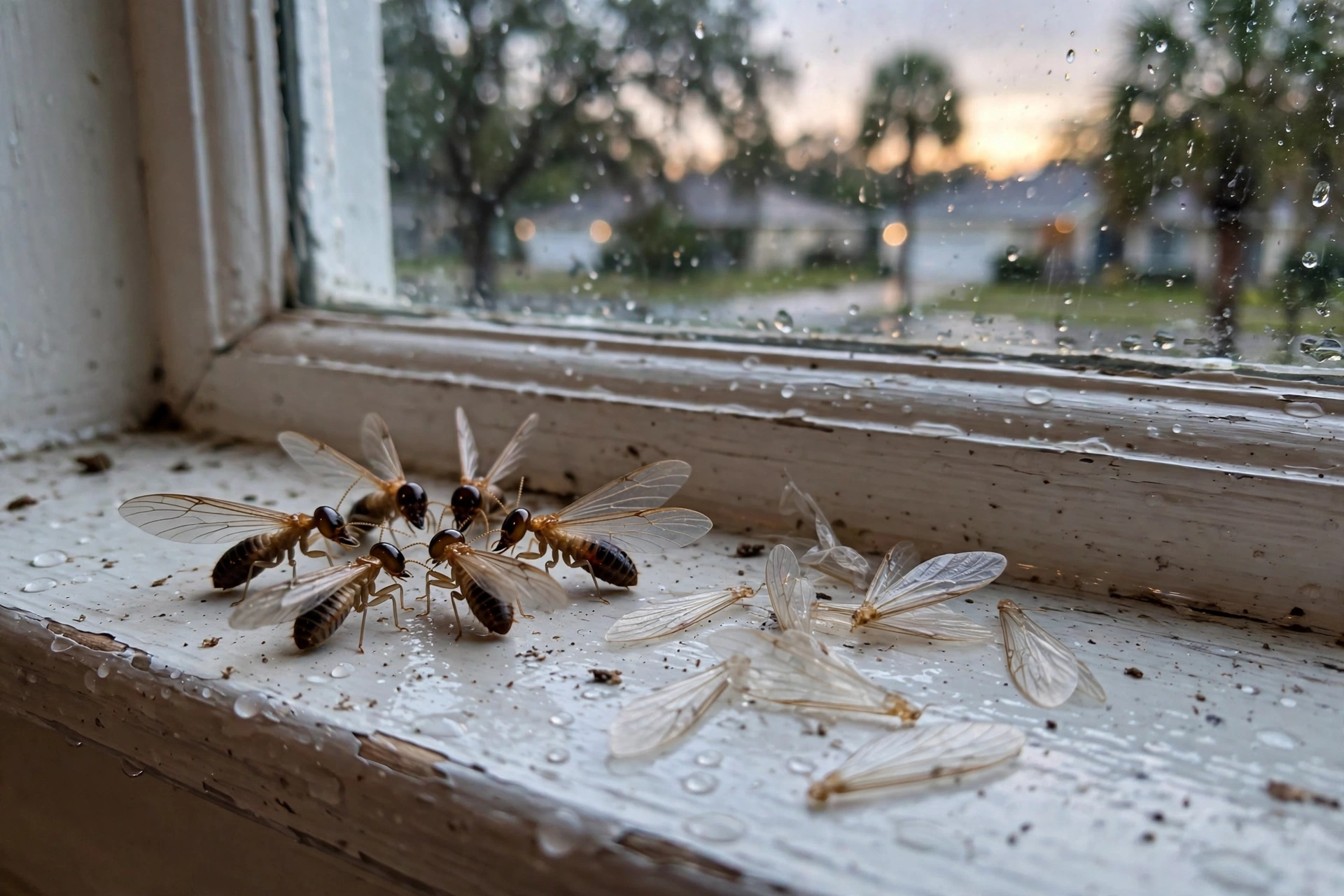
Swarmers around outdoor lights or in the pool may have come from a colony in a tree, a fence, or a neighbor’s house — worth noting, not panicking over. Swarmers INSIDE your home are different: they almost always mean a colony is established in your structure, close enough that its swarmers emerged indoors and flew to your windows and lights.
The shed wings tell the same story in miniature. Wings appearing on interior sills, week after week in season, are a colony’s signature written on your housekeeping.
What to do during a swarm
First: collect evidence. Sweep a sample of swarmers and wings into a sealed bag or jar — species identification drives every decision after this, and flying ants are the great impersonator. Photograph where you found them; the locations hint at the colony’s position.
Second: resist the spray can. Killing the swarmers you can see does nothing to the colony inside the wood, and spraying into cracks and trim can scatter the evidence an inspector needs. Vacuuming up the swarmers for tidiness is fine — just keep your sample first.
What a swarm means for treatment
One outdoor swarm near your home earns vigilance: check for frass and kickout holes, and consider an inspection. An indoor swarm means an established colony — typically years old, since colonies swarm only at maturity — and it should be inspected and mapped promptly.
The map decides the treatment as always: swarmers traced to one piece of furniture is one answer; frass in the attic plus indoor swarmers is the whole-structure conversation. Either way, swarm season is the cheapest time to learn the truth, because the colonies are announcing themselves.

Preparing for next season
Reduce the welcome mat: fix roof and fascia rot swarmers exploit, clear wood debris and firewood away from the structure, and keep attic vents screened. None of this makes a home termite-proof, but swarmers choose landing spots, and sound, dry, sealed wood is a worse target than cracked and weathered trim.
And keep last year’s lesson: if your home produced an indoor swarm last spring and nothing was done, this season’s inspection is overdue. Colonies do not leave on their own.
The peak runs roughly March through June in Central Florida, on warm humid evenings, often right after rain. Timing shifts with the weather year to year.
Yes — wings are shed within minutes of landing and are often all that remains visible. A windowsill of wings in season is evidence of a swarm event, and indoors it points to a colony in the structure.
Not on the swarm alone — on the inspection it should trigger. The colony map, not the swarm, is what justifies fumigation or a smaller treatment.
Related Services & Guides
Have This Problem at Your Home?
Guides explain the problem — an inspection shows whether it is yours. One call connects you with an independent local fumigation provider in the Oviedo area.
Call (888) 555-0199 →Get in Touch with Us
The fastest way to reach a local fumigation provider is by phone. Prefer to write it down first? Send the short form — describe what you are seeing (frass, swarmers, damaged wood), where in the home, and since when.