How to Identify Drywood Termites: Frass, Wings & Kickout Holes
Drywood termites live inside the wood they eat, so homeowners almost never see the insects themselves — they see the evidence. This guide teaches you to read that evidence the way an inspector does: the pellets, the wings, the holes, and the sounds, and how to tell drywood signs from everything else that looks like them.
Frass: the sign that gives them away
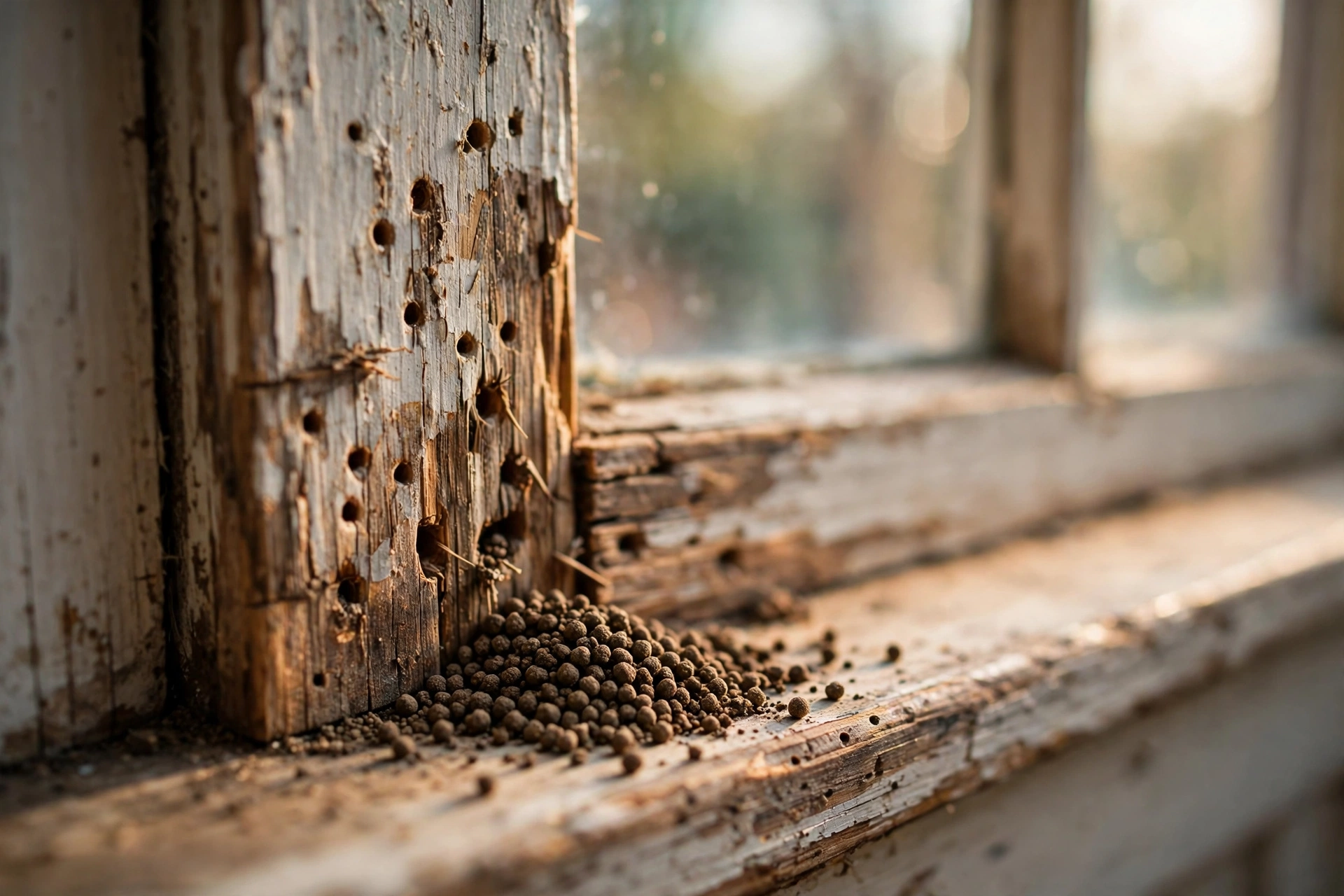
Drywood termites push their droppings — frass — out of the colony through tiny kickout holes, and it collects in little piles below. Frass looks like coarse ground pepper or tiny oval pellets, often in mixed shades of tan and brown, and it appears under window frames, baseboards, furniture, and door casings. The pile’s location is a map: the colony is directly above it, inside that piece of wood.
The test is repetition. Sweep the pile up completely; if it returns within days, something above is actively producing it. Old frass from a dead colony does not reappear — returning frass means a living colony, now.
Swarmers and shed wings
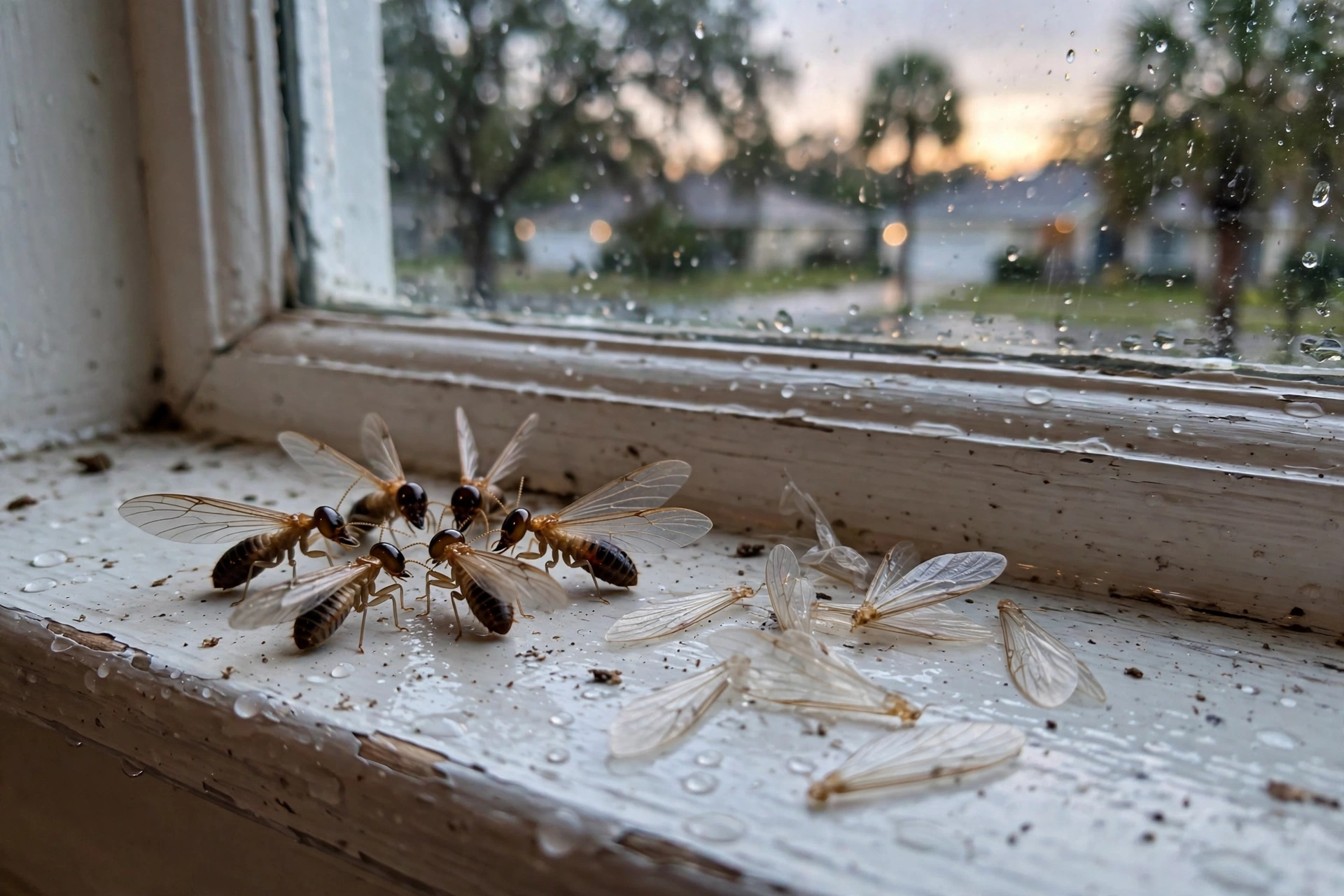
In swarm season, mature colonies release winged termites (alates) that fly toward light, shed their wings, and pair off to start new colonies. Finding papery, translucent wings on windowsills, in spider webs near lights, or floating in the pool — or the swarmers themselves, small pale-brown insects with two pairs of equal-length wings — means a mature colony is close: either in your structure or close enough to matter.
Save a few in a sealed bag or jar. Identification matters — flying ants are the great lookalike — and a provider can confirm the species from your sample in seconds.
Kickout holes and damaged wood
Kickout holes are pinholes, often barely a millimeter or two, in painted or finished wood — the colony’s exit door for frass. They may be sealed over with a plug of frass and hard to spot until you look along trim in raking light. Wood with an established colony sounds hollow or papery when tapped with a screwdriver handle, and paint may blister or show a dimpled, uneven surface over the galleries beneath.
In advanced cases the surface gives way under pressure — a vacuum crevice tool crunches through trim that looks perfect from two feet away. That fragility, combined with frass, is close to a certain diagnosis.
Drywood signs vs. the lookalikes
Carpenter ants leave frass too — but theirs is coarse, fibrous sawdust with insect parts mixed in, not neat oval pellets. Powderpost beetles leave flour-fine powder and round exit holes in hardwoods. Flying ants have pinched waists and uneven wings; termites have straight antennae, uniform waists and equal wings. Subterranean termites announce themselves with mud tubes — drywoods never build them.
When the signs are ambiguous, an inspection settles it. What matters is not to ignore a confirmed pattern: a drywood colony identified this year is a smaller treatment than the same colony found in three years.
What to do when you’ve confirmed the signs
Photograph the frass piles and note where they are; do not spray inside the wood or plug the kickout holes — both scatter evidence an inspector needs, and neither reaches the colony. Then get the structure inspected and mapped: the visible colony may be the only one, or the first of several.
The map decides the treatment. A truly single, accessible colony may need only localized treatment; activity in several places points to whole-structure fumigation. Either way, you will be deciding from evidence — which is exactly how it should work.
Rarely — workers stay inside the wood. You may see swarmers in season, or workers if infested wood is broken open. Identification normally rests on frass, wings and kickout holes, confirmed by an inspector.
Not an emergency, but not nothing. A returning frass pile means an active colony feeding now. It earns a prompt inspection, not panic — and not a can of spray, which only hides the evidence.
Established colonies can produce faint clicking or rustling inside wood when disturbed — soldiers bang their heads as an alarm. Most homeowners never hear it; silence proves nothing either way.
Related Services & Guides
Have This Problem at Your Home?
Guides explain the problem — an inspection shows whether it is yours. One call connects you with an independent local fumigation provider in the Oviedo area.
Call (888) 555-0199 →Get in Touch with Us
The fastest way to reach a local fumigation provider is by phone — describe what you are seeing (frass, swarmers, damaged wood), where in the home, and since when.